
Sun Protective Clothing Manufacturing: How UPF Is Engineered, Tested and Substantiated
Sun protection has quietly become one of the most requested features in activewear, and it is no longer a seasonal niche. Citing WGSN data, CNN reported in August 2026 that 34% of full-price UPF items were sold out this year, up 11.4 percentage points from 2025, against a 25% sell-out rate for apparel overall. EDITED put growth at US activewear brands at 12% year on year in May. The demand is real, and it now reaches far beyond beach cover-ups: golf, tennis, pickleball, running, hiking, resort, swim, kidswear and workwear all carry UPF claims.
The demand also arrives with a problem that most product development teams hit sooner or later. UPF looks like a property of a fabric. It isn’t. It is a measurement taken on a specific specimen, in a specific physical state, under a specific test method — and it moves a great deal when any of those change. For anyone specifying sun protective clothing manufacturing, the distance between the number on the mill’s spec sheet and the number your customer’s garment actually delivers is where product performance, labeling compliance and claim risk all meet.
What UPF Actually Measures, and What It Doesn’t
UPF — ultraviolet protection factor — is a ratio. It compares how much erythemally weighted UV radiation reaches unprotected skin with how much reaches skin covered by the fabric. Under AATCC TM183, the standard US laboratory method, a specimen is mounted flat at the port of an integrating sphere attached to a spectrophotometer, and transmittance is measured across roughly 280–400 nm. Because the sphere captures scattered light rather than only direct transmission, the result reflects how the whole fabric structure behaves, not just how much yarn is in the way. Raw readings are then weighted against the erythemal (sunburn) action spectrum and a reference solar spectrum.
Two consequences matter for development.
First, UPF is not SPF, and the distinction is not cosmetic. SPF describes protection against UVB only. UPF covers the full solar UV band, UVA and UVB together, weighted for the wavelengths that actually cause erythema. A high UPF rating is broad-spectrum protection by construction of the measurement, not by formulation.
Second, the printed number is capped. UPF 50 means roughly one-fiftieth of effective UV gets through, so a 50+ rating blocks about 98%. Standards stop there because above that level the transmittance readings sit so close to zero that further precision is measurement noise, and the incremental clinical benefit is negligible. Under the US labeling guide ASTM D6603, the classification bands run 15–24 (good), 25–39 (very good) and 40–50+ (excellent), with UPF 15 as the floor below which a fabric should not be labeled sun protective at all.
So far this reads like a fabric attribute. It isn’t, and here is why.
The States That Decide Whether UPF 50+ Is Real
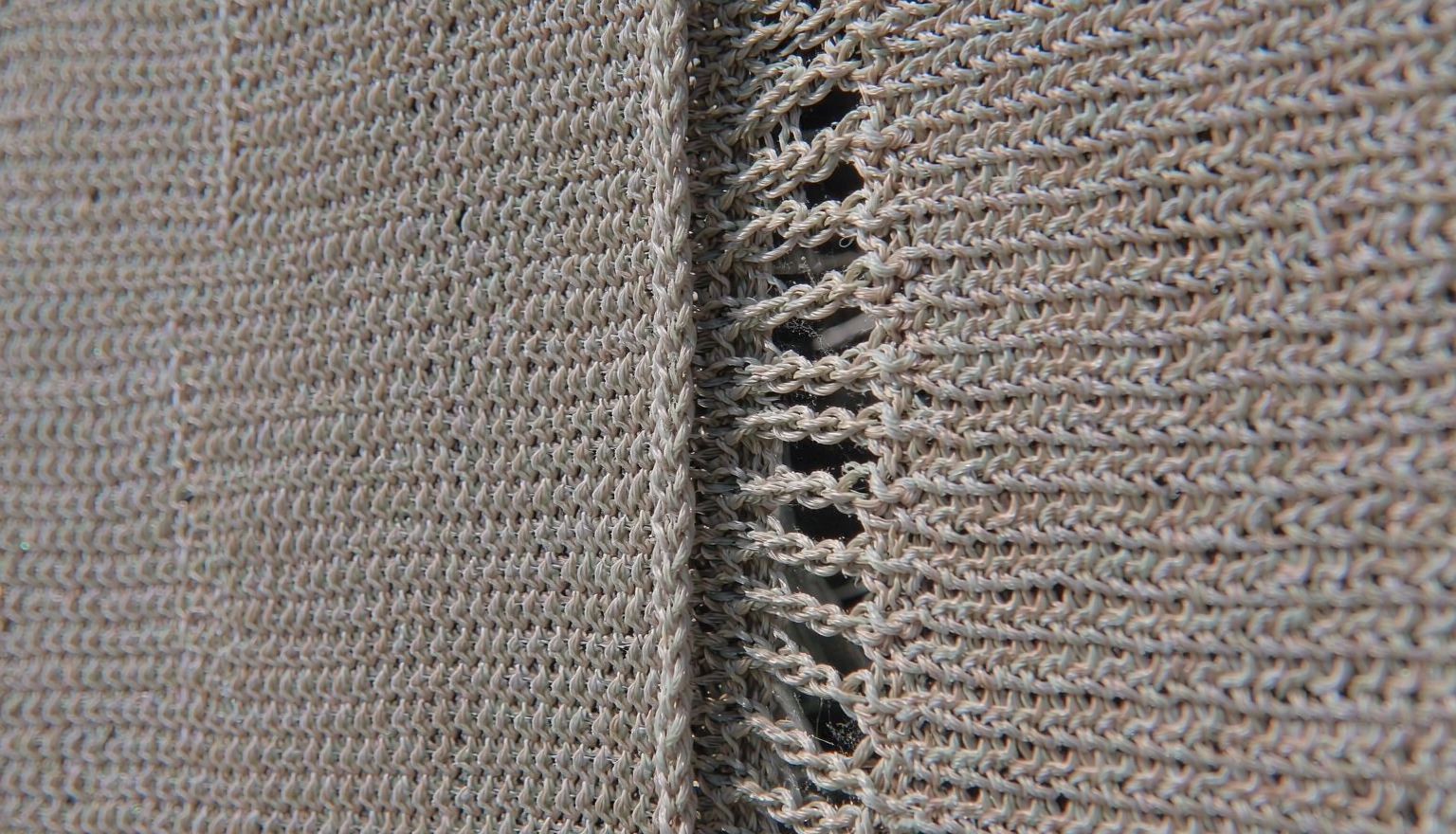
Every UPF figure describes fabric in a defined state. The four states that matter are dry, stretched, wet and aged — and your customer wears the garment in all four at once.
Stretch is the one brands underestimate most. In a 2015 study published in Radiation Protection Dosimetry, Wong, Lam, Kan and Postle assessed coloured cotton knitted fabrics and found that black knitted fabrics showed a reduction in UPF averaging 53% at just 10% stretch — roughly the strain a fitted garment carries across the shoulders. The same work found that fabrics incorporating miss stitches retained good UV protection even at 20% stretch. That second finding is the one worth the most attention: protection under stretch was recoverable through knit structure, not through heavier fabric or added chemistry.
Wetness changes the optics. When a knit wets out, water replaces the air in the interstices between fibres. Because the refractive indices of water and fibre are closer than those of air and fibre, light scattering drops and the fabric becomes optically more open. Kan and Yam, writing in Materials (2014), measured cotton and cotton/Coolmax plain knits at 30% stretch combined with wetting at several levels, and found UPF lowest in the wet-and-stretched condition — worse than either variable alone. Their work also showed the effect is solution-dependent: seawater degraded protection most in cotton-dominant fabrics, while chlorinated pool water produced comparatively higher readings because sodium hypochlorite brightens cotton and promotes reflection.
Put those together and the practical point writes itself. A dry, relaxed lab specimen is the most favourable possible version of your garment. Fitted activewear is stretched by design, and anything worn in a field, court or pool is wet at least part of the time. If your specification says “UPF 50+” and the supporting report was generated in the new, dry, unstretched state, the number describes a swatch, not the product.
Where UPF Comes From: Construction First, Then Everything Else
Four levers determine protection, and they are not equal.
Construction dominates. Geometry does most of the work. A dense construction simply leaves fewer and smaller gaps for radiation to pass. This is why the comparisons commonly cited by the Skin Cancer Foundation are so stark — a lightweight white cotton T-shirt around UPF 7 versus dark denim around UPF 1,700. Same spectrum, several orders of magnitude apart, because of coverage factor and yarn mass. In the PolyU work referenced above, models built from tightness factor, pore size ratio and stitch density explained most of the variance in measured UPF across stretch and wet conditions.
Fibre sets the ceiling. Polyester carries aromatic rings in its polymer backbone that absorb in the UV band, which is one reason PET is the default base for sun-protective knits. Nylon also performs well. Untreated cotton, linen and viscose are comparatively UV-transmissive and only reach high ratings through construction, colour or treatment — worth knowing before you assume a natural-fibre brief can carry a UPF claim unaided.
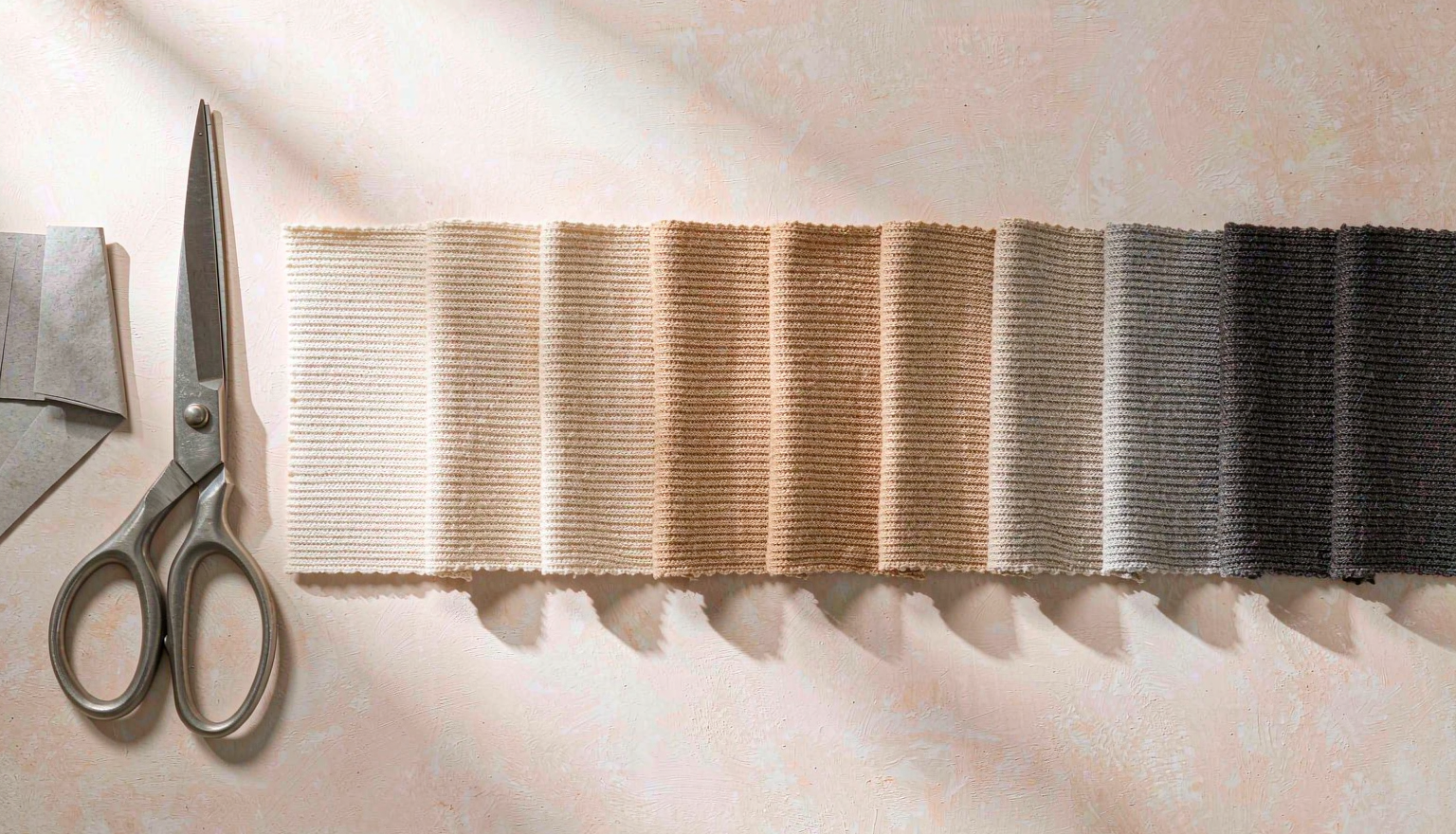
Colour helps, but cannot rescue an open structure. Deeper and more saturated shades generally absorb more of whatever radiation passes the gaps. Practical caveat for developers: pale colourways are where UPF failures concentrate, because they combine low construction help with low dye help.
Finish is the fragile lever. Titanium dioxide is widely used both as a delustrant and as a UV scatterer; organic UV absorbers of the benzotriazole type convert the photon to heat. Both can be introduced in the polymer or applied in finishing, and both can lose efficacy through washing, abrasion and chlorine exposure. The general development rule follows from this: reach target UPF primarily through construction, then use finish as a margin, and then prove durability with testing. A UPF rating that depends entirely on a surface finish is a rating with a shelf life.
That durability requirement is not theoretical. ASTM D6544 exists precisely to prepare textiles before UV transmission testing, subjecting them to repeated laundering, controlled UV exposure and chlorinated water immersion before re-measurement.
Reading the Standard Before You Read the Number
The same fabric legitimately produces different UPF values under different protocols, because the protocols test different states. Which one you should specify depends on where you sell and what you intend to claim.
| Method | Specimen state | What you get | Typical use |
|---|---|---|---|
| AATCC TM183 (US) | Dry, relaxed; wet optional | Spectral transmittance → UPF | Baseline US laboratory method |
| ASTM D6603 (US) | — | Labeling guide and protection classes | US hangtags and care labels |
| ASTM D6544 (US) | After laundering, UV exposure, chlorinated water | Pre-conditioning before measurement | Substantiating durability claims |
| AS/NZS 4399 (Australia / New Zealand) | New, dry, unstretched, relaxed against a Melbourne reference spectrum | UPF plus 15 / 30 / 50 / 50+ classes | AU/NZ market labeling |
| EN 13758-1 / EN 13758-2 (Europe) | Test method plus classification and marking | Lowest UPF above 40 and mean UVA transmission below 5%, with garment coverage requirements | EU / UK conformity route |
| UV STANDARD 801 (Hohenstein) | Worst case: stretched, wet, abraded and washed, against high-intensity solar spectrum and sensitive skin type | Worst-case UPF across approximately 15–80+ | The most demanding certification route |
Two practical notes. First, AS/NZS 4399, EN 13758-1 and AATCC TM183 describe new, dry, unstretched fabric — they are not wrong, they are simply measuring the optimistic end. UV STANDARD 801 was built to close exactly that gap, which is why it is the route that tends to survive a marketing review or a retailer technical file. Second, coverage is part of the European requirements, not a design suggestion: EN 13758-2 sets specific expectations for what a garment must cover, which makes it a fabric selection decision made alongside construction rather than an afterthought at fabric approval.
Compliance: Europe Is Mandatory, Everywhere Else Is Substantiated
This is the part that most often surprises brands moving into sun protection for the first time.
In the European Union, a UV-protection claim is not a marketing choice. On the basis of SGS’s SafeGuardS 044/19 guidance, since 21 April 2019 any garment claiming to protect the wearer’s skin from the sun — including hats, gloves and swimwear — has had to be CE marked as personal protective equipment under Regulation (EU) 2016/425, classified as Category I. The PPE Regulation’s own guidelines list garments designed and manufactured to have specific UV-protective properties against natural UV radiation as Category I PPE. In practice that means classification as Category I, testing to EN 13758-1 and EN 13758-2, achieving the thresholds discussed above, affixing the CE mark, carrying the standard’s mandatory warnings, and assembling a technical file retained for ten years. Because EN 13758-1 is not a harmonised standard, the technical file route differs slightly from a fully harmonised route. SGS also recommends re-measuring UPF after multiple wash cycles, since the PPE Regulation requires that any loss of protection through cleaning be disclosed. Note for UK supply: from 1 January 2021 PPE for the UK market is regulated under a UK version of Regulation 2016/425 requiring the UKCA mark, and UK sun hats with UPF claims are typically handled under BS 8466.
In the United States there is, as of October 2026, no mandatory federal standard for UV-protective apparel. Claims are voluntary — but they are not unregulated. Advertising a UPF value requires competent and reliable substantiation, which in practice means holding current test reports from an accredited laboratory for the exact fabric and construction being sold. Our earlier analysis of PFAS restrictions in textile finishing covers the same principle from the chemistry side: the claim follows the evidence, and the evidence must be current.
Australia and New Zealand sit closer to the US position in formal terms but carry strong consumer expectation of AS/NZS 4399 testing.
Budgeting Testing Without Buying False Confidence
There is no monthly finding here, only arithmetic worth doing early. UPF testing multiplies across three axes: fabric construction, colourway, and specimen state. A four-colour capsule in two constructions, tested in one state, is a fraction of the cost of the same range tested in three states across every colourway.
Tiering is the useful response. Test the base cloth in its darkest and lightest colourway, since those typically bracket the range. Test the tightest and the loosest construction in the line. Add wet and stretched states where the product calls for it — fitted activewear, swim, court sports, anything sold with a perspiration story. Add after-laundering only where you are claiming lasting protection, which is every time you print a number on a hangtag. And treat every mill-supplied UPF figure as the beginning of a conversation, not the end: ask for the report, the issue date, the laboratory accreditation, the standard used, the specimen state, and whether it covers your colourway at your GSM.
What This Means for Designers, PD and Sourcing Teams
Design. UPF only protects what it covers. Sleeve length, collar height, hem drop, thumbholes, back yoke construction and leg length are all protection decisions, and several are explicitly codified in EN 13758-2. The cheapest UPF improvement available to most lines is two centimetres of sleeve.
Pattern. Negative ease opens pores. Any panel where the knit is under high strain — across the shoulders, over the chest, at the outer thigh — is a candidate local protection minimum. Mesh inserts and open-work structures should be placed with that in mind, or backed if they sit over high-exposure zones. It is worth revisiting the point we made in fabric performance versus wear experience: a lab figure describing flat cloth and a measurement taken on a body in a wearing position routinely disagree.
Tech pack. Specify inputs you can actually police in production — stitch density, GSM, yarn type, filament versus staple, delustrant content, construction. Specifying only the outcome (“UPF 50+”) leaves no lever to pull when the bulk lot comes in at 38. This is one of the recurring causes we catalogued in why activewear samples fail during development: targets written as outcomes rather than as constructions.
Quality. You will not put every roll through a spectrophotometer, but the attributes that drive UPF — mass per unit area, stitch density, cover factor — are all cheap to verify. Hold them as incoming tolerances and re-test in the laboratory on a defined per-lot frequency. Always test the finished garment where you can, because seams, linings and trims change the picture.
Sourcing. Samples and cost planning for UPF programmes differ enough from standard development that they deserve a line in the budget rather than an assumption. Our breakdown of garment production cost factors covers where third-party testing sits in a landed cost model, and apparel MOQ dynamics explains why testing per colourway interacts awkwardly with small colour buys — a common friction point in this category specifically.
Does UPF wash out? It depends entirely on how it was achieved. Protection delivered by construction and by delustrant inside the fibre is largely stable. Protection delivered by a surface-applied finish degrades with laundering, abrasion, chlorine and prolonged sunlight. If you do not know which one you bought, you do not know what your customer has after twenty washes.
Where Sun Protective Clothing Manufacturing Goes Next, as of October 2026
Three developments are worth building into planning now.
Growth plus scrutiny. The category is moving from specialist to mainstream faster than its labeling conventions are settling. Sell-out rates like the ones WGSN reported make UPF claims more commercially valuable, which in turn makes them more likely to be challenged by retailers, competitors and regulators. Get the substantiation file in order before you scale the range, not after.
Durability is becoming the differentiator. A UPF 50+ claim that survives twenty washes and a worst-case test is defensible; one that was true of a dry swatch is not. Over the next few seasons, expect worst-case protocols to move from premium certification to baseline expectation.
Structural solutions are the compatible ones. Construction-based protection requires no additional chemistry, ages better, and fits more easily alongside the recyclability and material-disclosure work already reshaping European product requirements than a finish-dependent approach does. When two development routes deliver the same rating, prefer the one that survives washing and does not add substances to your restricted-substance screening.
The practical advice is unglamorous: decide which market you are selling into, choose the protocol that matches its strictest requirement, write the protection target into the tech pack as a construction specification rather than a promise, and keep the reports current. Sun protective clothing manufacturing rewards teams who treat UPF as a measured outcome of decisions they control — not as a property they buy.
References
- CNN, “This summer’s hottest accessory: Sun protection,” 16 August 2026 — WGSN, EDITED and Trendalytics data on UPF sell-outs, search interest and inventory mix: https://us.cnn.com/2026/08/16/business/uv-the-future-of-fashion
- Wong WY, Lam JKC, Kan CW, Postle R. “In Vitro assessment of ultraviolet protection of coloured cotton knitted fabrics with different structures under stretched and wet conditions.” Radiation Protection Dosimetry, 2015; 164(3): 325–334. doi:10.1093/rpd/ncu276
- Kan CW, Yam LY. “Effect of Stretching on Ultraviolet Protection of Cotton and Cotton/Coolmax Blended Weft Knitted Fabric in a Wet State.” Materials, 2014; 7(1): 58–74: https://pmc.ncbi.nlm.nih.gov/articles/PMC5453141
- Yam LY. A study on ultraviolet protection factor of cotton and Coolmax based on plain knitted structure (M.Phil. thesis), The Hong Kong Polytechnic University, 2013: https://ira.lib.polyu.edu.hk/handle/10397/84081
- SGS, SafeGuardS 044/19, “Solar UV Protection and Clothing (UPF Claims),” effective 21 April 2019 — CE marking, Category I PPE, technical file and labelling requirements: https://www.sgs.com/en/news/2019/04/safeguards-04419-solar-uv-protection-and-clothing-upf-claims
- Regulation (EU) 2016/425 of the European Parliament and of the Council on personal protective equipment: https://eur-lex.europa.eu/eli/reg/2016/425/oj
- CEN, EN 13758-2:2003+A1:2006, Textiles — Solar UV protective properties — Part 2: Classification and marking of apparel — UPF above 40, mean UVA transmission below 5%, coverage and mandatory warnings: https://standards.iteh.ai/catalog/standards/cen/d968fb10-2a29-4c84-a954-a33d9d0e25cf/en-13758-2-2003a1-2006
- Hohenstein, developer of UV STANDARD 801 — worst-case UPF assessment under stretch, wetness, abrasion and laundering: https://www.hohenstein.com/en
- AATCC Test Method 183 (transmittance or blocking of erythemally weighted ultraviolet radiation through fabrics), ASTM D6603 (labeling UV-protective textiles) and ASTM D6544 (preparation of textiles prior to UV transmission testing), AATCC and ASTM International.
- The Skin Cancer Foundation, Seal of Recommendation requirements for UV-protective fabrics — minimum UPF 50, as published in its Seal of Recommendation criteria.