
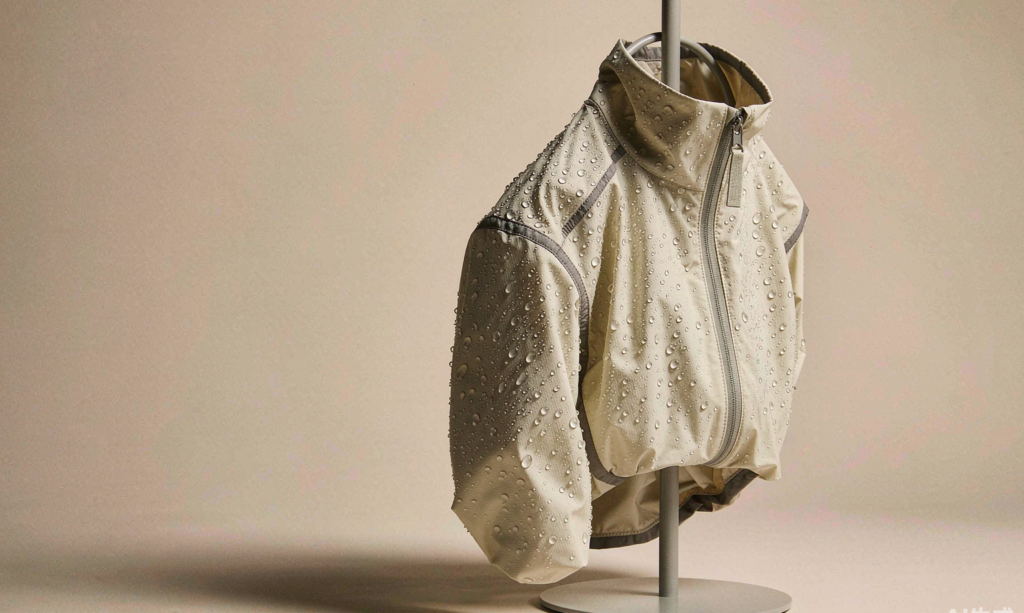
Most regulatory deadlines in apparel arrive as a memo from the compliance team. This one arrives as a fabric specification.
On 10 October 2026, the European Union begins enforcing a ceiling of 25 parts per billion for the sum of PFHxA and its salts — and 1,000 ppb for the sum of PFHxA-related substances — in textiles, leather, furs and hides used in clothing and related accessories for the general public. The restriction sits in Entry 79 of Annex XVII to REACH, inserted by Commission Regulation (EU) 2024/2462 [1]. For a brand shipping a water-repellent shell into the EU, that number is not a legal abstraction. It is a property of a finish that someone specified, on a fabric that someone booked, in a tech pack that someone signed off many months earlier.
That is why this deserves the attention of designers, product developers and sourcing managers, not only lawyers. PFAS compliance is now decided long before production — at the point where a finish is written into a spec. This piece maps what changes, where fluorine-free chemistry genuinely performs, where it does not, and what the switch does to your calendar and your unit economics.
What actually changes on 10 October 2026
The EU restriction, in plain terms. Entry 79 applies from 10 October 2026 to textiles, leather, furs and hides in clothing and related accessories for the general public, and to footwear for the general public. The limits are 25 ppb for the sum of PFHxA and its salts and 1,000 ppb for the sum of PFHxA-related substances, measured in homogeneous material [1].
“Homogeneous material” carries real weight. The limit is assessed per material, not averaged across a finished garment, so a compliant shell fabric does not rescue a non-compliant seam tape or zipper tape. Two further points are routinely missed. First, the restriction is not limited to what a mill adds on purpose: PFHxA-related substances are defined by their potential to degrade or be transformed into PFHxA, which brings side-chain chemistry into scope [1]. Second, paragraph 7 of the entry exempts articles and mixtures that were placed on the market before 10 October 2026 [1] — a stock-planning question rather than a loophole to build a season around.
Exemptions exist for certain categories of personal protective equipment, medical devices and construction textiles [1]. Non-clothing textiles for the general public — curtains, upholstery, bed linen — follow a year later, on 10 October 2027 [1].
The national layer arrived first. France banned PFAS in consumer textiles, footwear and waterproofing agents from 1 January 2026 under Law No. 2025-188 and its implementing decree, with exemptions that include clothing and footwear incorporating at least 20% recycled material from post-consumer waste, and with the ban extending to all textiles by January 2030 [2]. Denmark restricts clothing and footwear at or above 50 mg F/kg total fluorine from 1 July 2026 [2][3]. The practical consequence is that there is no single European date to plan against: the binding constraint is whichever market you actually ship to.
The United States is a patchwork with a moving threshold. California’s AB 1817 has prohibited new textile articles containing regulated PFAS since 1 January 2025, where “regulated PFAS” means either PFAS intentionally added for a functional or technical effect, or total organic fluorine at or above 100 ppm [4]. That threshold drops to 50 ppm on 1 January 2027 [4][5]. Outdoor apparel for severe wet conditions is deferred until 1 January 2028, but it is not exempt — from 1 January 2025 those products must carry the disclosure “Made with PFAS chemicals”, explicitly including online listings [4][6]. New York banned intentionally added PFAS in new apparel from 1 January 2025, with the same 2028 deferral for severe-wet-conditions outdoor apparel [4]. Maine prohibited most textile articles containing intentionally added PFAS from 1 January 2026, and several further states have reporting or phase-in obligations landing across 2026 and 2027 [2].
One clause deserves more attention than it usually gets. California requires manufacturers to use the least toxic alternative when removing regulated PFAS, and the statute expressly contemplates alternative *design*, not only alternative chemistry [6]. Swapping in a different problematic finish is not compliance.
Why this belongs in the tech pack, not the legal file
PFAS almost never enters a garment through the fibre. It enters through function — durable water repellency, stain release, oil and grease resistance — which means it arrives via a finishing line, a membrane, a seam tape, a zipper tape, a thread or a print [7]. Each of those is a separate line on a bill of materials, and each can be the reason a compliant shell fabric fails once assembled into a garment.
The design consequence is that “does this product need the finish at all?” becomes the first question rather than the last. A base layer, a mesh panel or a yoga tight has no performance reason to carry a repellent finish. Removing it entirely is the cheapest and most defensible specification change available, and it is a decision only the product team can make — no testing budget required.
Where repellency genuinely is required, the spec has to name the chemistry. Leaving finish selection to the factory at bulk stage is the most common failure mode in this transition, because the finish applied in production then differs from the finish validated in sampling [8]. Brands that build a disciplined fabric-selection process into development tend to catch this early; brands that treat sourcing as a late-stage purchasing step tend to meet it at the port.
What fluorine-free chemistry does well — and where it stops
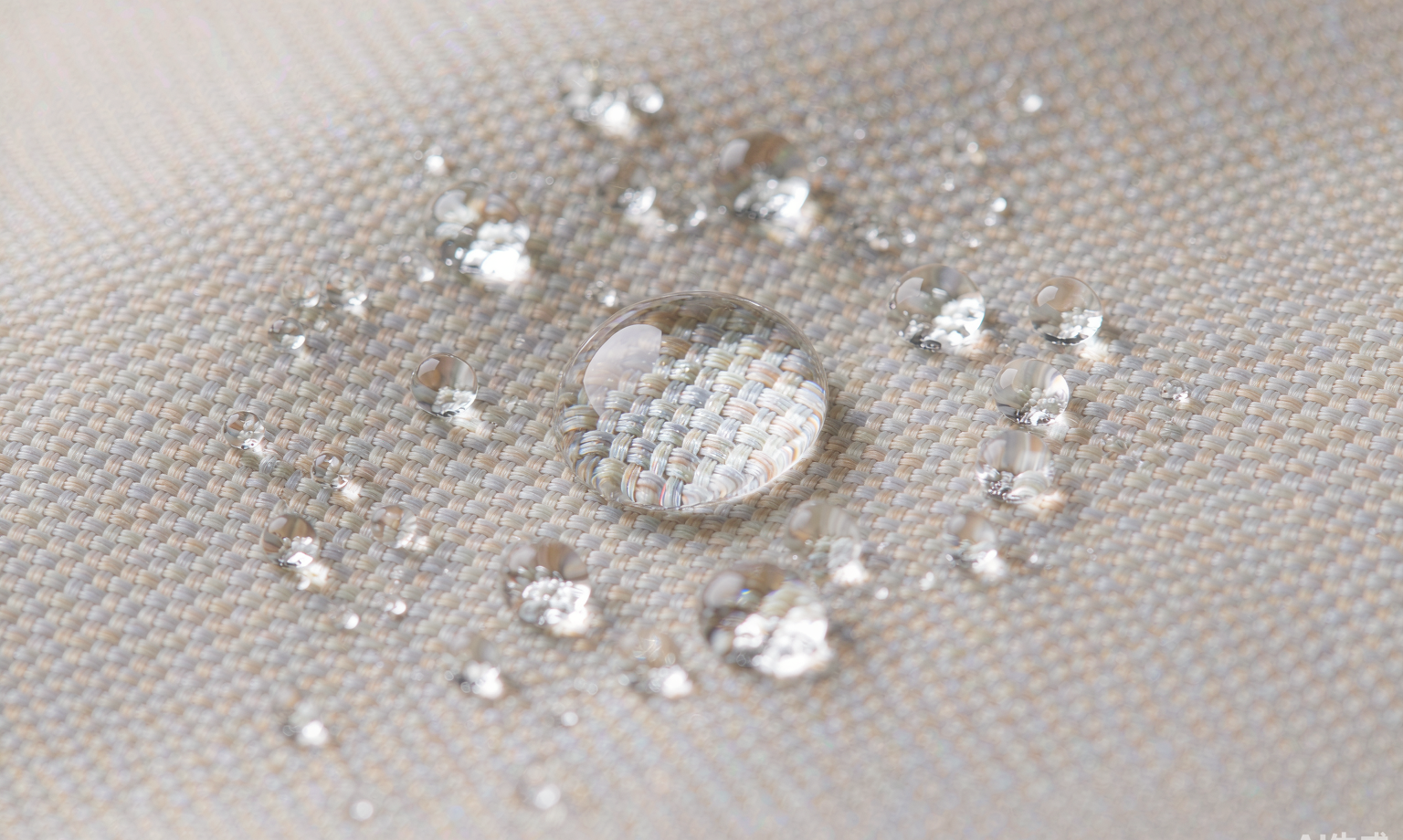
Non-fluorinated (C0) repellents are not one technology. The main families are hyperbranched and dendrimer polymers, silicone (PDMS) systems, paraffin and plant-wax emulsions, and polyurethane or acrylic formulations [3]. They differ meaningfully in hand feel, cure requirements, wash durability and cost, and they should be selected by product category rather than applied as a blanket substitute across a range.
The hard limit is physical rather than commercial. Water has a surface tension of roughly 72 mN/m, so a surface only needs to sit below that to shed water. Common oils sit around 18–33 mN/m, and pushing a surface below that figure remains largely fluorinated chemistry’s territory [3]. In test terms this shows up as a genuine gap in oil repellency — AATCC TM118, graded 0 to 8 — even when spray-test results look comparable [3][9]. If a product’s marketing depends on oil or stain resistance, that claim is the part of the line most likely to need rewriting.
Durability is the second trade-off. Non-fluorinated finishes generally lose repellency faster under washing and abrasion than legacy fluorinated ones, and many recover partially through heat re-activation: a warm tumble or press reorients the polymer chains and beading returns [3]. That is a care-label and consumer-education issue as much as a laboratory one, and it should be reflected in the instructions you print.
Two measurements are worth fixing in the spec, because they measure different things. Repellency — spray test, ISO 4920 / AATCC 22 — describes whether water beads on the surface. Water penetration under pressure — hydrostatic head, ISO 811 — describes whether it gets through. A finish can fail spray and the garment can still be waterproof; a garment can bead beautifully and still leak under pack-strap pressure [3]. Specify both, with pass levels matched to how the product is actually used. This gap between fabric performance and wear experience is where most disappointed customers originate.

The evidence problem: a mill declaration is not a compliance file
The most expensive misunderstanding in this transition is treating a supplier’s “PFAS-free” statement as sufficient. A declaration is a starting point, not evidence. What turns a document into evidence is linkage — a test report or declaration that can be tied to a specific material, style, purchase order and production lot [7]. A valid certificate that cannot be matched to the batch inside the carton is close to worthless when a customs authority, a marketplace or a retail compliance team asks.
On method, the distinction that matters is between total fluorine screening and targeted compound analysis. Total organic fluorine is fast and broad, good for triage, and it is the language California’s threshold is written in [4][5]. The EU’s PFHxA limits are compound-specific [1]. A programme built on only one of the two will have blind spots, and neither substitutes for a certification and compliance framework that holds supplier documents together over time.
California also requires a certificate of compliance from the manufacturer to anyone offering the product for sale in the state. Because that certificate attests compliance with the chapter rather than with a fixed number, it does not carry forward when the threshold tightens in 2027 [6].
What it costs, and where it lands in the calendar
Compliance testing is priced per sample, and PFAS work is priced per material. That means the bill scales with component count and colourway count, not with order quantity — which quietly penalises small runs. A brand producing 300 units of a four-component shell across three colourways pays for roughly the same testing programme as a brand producing 30,000, spread across far fewer units. For emerging brands, the sensible response is to consolidate finishes across a collection and to reduce the number of distinct treated materials in any single style. It is one of the less obvious levers in the garment production cost breakdown.
The schedule matters more than the fee. Testing, result review, and — if something fails — re-sourcing and re-sampling form a loop that adds weeks to a development calendar [8]. Mills running qualification batches for reformulated finishes also tend to quote longer lead times than their conventional ranges during a transition. The mitigation is sequencing: validate the finish during sampling, lock the approved chemistry into the tech pack, and treat any change of mill, recipe or finish as a change-control trigger requiring re-test [5]. Teams that already struggle with sample failure in development will recognise the pattern — an unmanaged variable introduced late, discovered late.
A working checklist for designers, product developers and sourcing teams
- Audit function, not fibre. List every SKU by whether it needs water repellency, oil repellency, stain release, or nothing at all. Delete finishes that serve no function.
- Map the full bill of materials. Shell, lining, membrane, seam tape, zippers, thread, elastic, prints, labels and packaging.
- Name the chemistry in the tech pack. Specify the approved finish and a named fallback; do not leave the choice to bulk.
- Collect linked evidence. Declarations and test reports tied to material, lot and purchase order — not generic certificates.
- Specify both test axes. Repellency (ISO 4920 / AATCC 22) and hydrostatic head (ISO 811), with pass levels matched to real use.
- Build change control. Any mill, recipe or finish change triggers re-approval and re-test.
- Review the claims. “PFAS-free”, “fluorine-free” and “waterproof” carry different meanings in different jurisdictions; check hangtags, care labels and online copy against the evidence you actually hold.
Brands that work through this at specification stage will find the transition manageable. Brands that discover it at the port will find it expensive — and given the 10 October 2026 date, some will find it in the middle of a season they cannot re-cut. Working with a manufacturing partner that treats quality as a system rather than a final inspection is what separates the two.
What to watch next
The EU’s universal PFAS restriction proposal — covering a far larger group of substances than PFHxA alone — remains under evaluation by ECHA and is not in force; any date attached to it should be treated as indicative [2][3]. In the United States, the California threshold tightens to 50 ppm on 1 January 2027 [4][5]. Separately, the EU’s Ecodesign for Sustainable Products Regulation names textiles a priority category, with a textile-specific delegated act still to be adopted and Digital Product Passport requirements following after it [10] — one more reason to get material composition and supplier data into structured fields now rather than into PDFs.
FAQ
Does PFAS-free mean the garment is no longer waterproof? No. Waterproofness comes from construction — membrane, seam sealing, hydrostatic head — not from the DWR finish alone. What fluorine-free chemistry gives up is primarily oil and stain repellency, and some wash durability [3].
Is a supplier’s “PFAS-free” certificate enough on its own? Rarely. It needs to be linked to the specific material and lot, and it is far stronger when supported by a test report using an appropriate method [7].
Which market should we design to? The strictest one you sell into. With France, Denmark, California, New York and Maine all operating on different clocks, designing to a single notional “EU” or “US” standard is how gaps appear [2][4].
We only make leggings and t-shirts. Does this affect us? Less, but not zero. The risk concentrates in treated components — prints, coatings, trims — and in cross-contamination from shared finishing lines. A functional audit of the bill of materials is still the right first step [7][8].
References
- [1] Commission Regulation (EU) 2024/2462 of 19 September 2024 amending Annex XVII to Regulation (EC) No 1907/2006 (REACH) as regards undecafluorohexanoic acid (PFHxA), its salts and PFHxA-related substances (Entry 79). https://eur-lex.europa.eu/eli/reg/2024/2462/oj
- [2] bluesign, “PFAS in Clothing: 2026 Bans, Health Risks, and Safer Alternatives” (accessed September 2026). https://www.bluesign.com/en/pfas-in-clothing
- [3] Fersan Tekstil, “Durable Water Repellency (DWR): PFAS-Free Chemistry and Durability”. https://www.fersantekstil.com/en/knowledge/durable-water-repellent-pfas-free.html
- [4] Morgan Lewis, “New York and California: Bans on PFAS in Textiles and Apparel Begin January 1, 2025” (November 2024). https://www.morganlewis.com/pubs/2024/11/new-york-and-california-bans-on-pfas-in-textiles-and-apparel-begin-january-1-2025
- [5] Eurofins Sustainability Services, “California PFAS Regulations: A Compliance Checklist for Consumer Products”. https://sustainabilityservices.eurofins.com/?p=28802
- [6] Textile School, “Safer Clothes and Textiles Act — California Health and Safety Code, added by AB 1817 (2022)”. https://www.textileschool.com/regulations/safer-clothes-and-textiles-act-california-health-and-safety-code-added-by-ab-1817-2022
- [7] Evidnt, “PFAS in Textiles: What Fashion and Outdoor Brands Need to Know”. https://evidnt.com/pfas-in-textiles-what-fashion-and-outdoor-brands-need-to-know
- [8] UniOuter, “No PFAS, No Panic: How Outdoor Jacket Manufacturers Are Preparing for the 2026 EU Ban”. https://www.uniouter.com/blog/No-PFAS-No-Panic-How-Outdoor-Jacket-Manufacturers-Are-Preparing-for-the-2026-EU-Ban_b30766
- [9] Hushbasket, “Hydrophobicity in Outdoor Textiles: DWR Coating vs. Fiber-Level Treatment”. https://hushbasket.com/textiles/hydrophobicity-outdoor-textiles-dwr-coating-vs-fiber-treatment/
- [10] Traceable Digital, “EU Textile Digital Product Passport: What Fibre Composition and Environmental Data Will Be Required” (September 2026). https://traceable.digital/resources/blog/eu-textile-digital-product-passport-what-fibre-composition-and-environmental-data-will-be-required